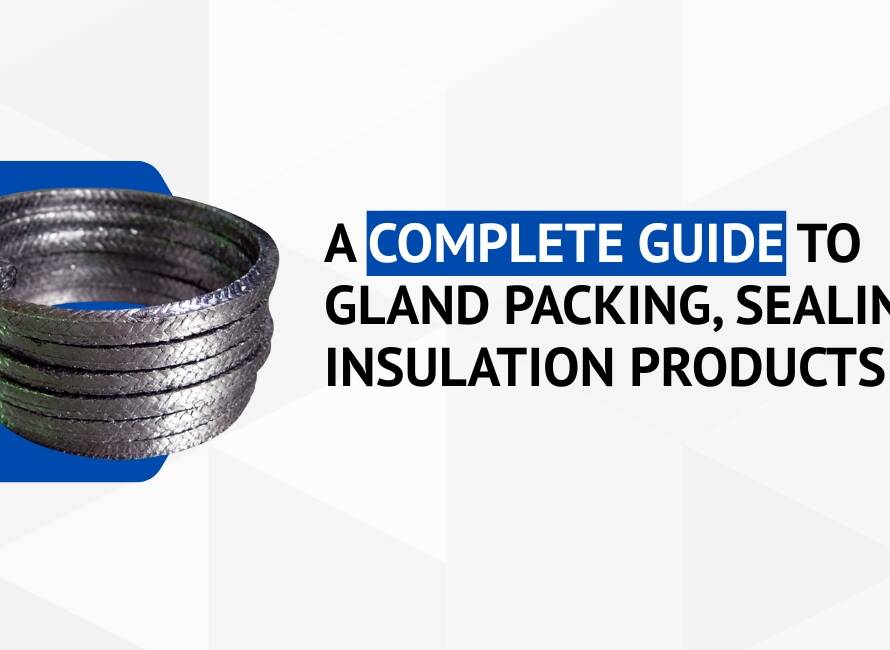
In industrial systems, controlling leakage and managing heat are two critical requirements that directly impact safety, efficiency, and equipment life. This is where sealing products and insulation products play distinct but complementary roles. While they are often discussed together, their functions, materials, and applications differ significantly.
Understanding the difference between a sealing product and an insulation product helps engineers, maintenance teams, and procurement professionals select the right solution for specific industrial challenges.
What Is a Sealing Product?
A sealing product is designed to prevent or control the leakage of fluids, gases, or vapors between two surfaces or around moving components. Sealing products create a physical barrier that maintains system integrity under pressure, temperature, and movement.
Common sealing products include:
- Gland packing
- Gaskets
- Mechanical seals
- O-rings
- Expansion joints
Sealing solutions for industries are widely used across power generation, oil & gas, chemicals, pharmaceuticals, and heavy manufacturing.
The primary purpose of a sealing product is to:
- Prevent leakage
- Maintain pressure
- Protect equipment and personnel
- Ensure process stability
What Is an Insulation Product?
An insulation product is used to control heat transfer by reducing heat loss or heat gain in industrial systems. Insulation products help maintain process temperatures, improve energy efficiency, and protect personnel from hot surfaces.
Examples of insulation products include:
- Ceramic fiber insulation
- Fiberglass insulation
- Mineral wool
- Calcium silicate boards
- Removable insulation jackets
These materials fall under industrial insulation products and are essential in environments where temperature control and thermal safety are critical.
Key Differences Between Sealing Products and Insulation Products – What You Need to Know
Although both product categories support efficient plant operations, their purposes are fundamentally different.
1. Function
Sealing products focus on stopping leaks and maintaining pressure. Insulation products focus on managing heat by limiting thermal transfer.
2. Operating Location
Sealing products are installed at joints, flanges, shafts, and interfaces where leakage can occur. Insulation products are applied over pipes, vessels, ducts, and equipment surfaces.
3. Performance Criteria
Sealing performance depends on compression, material resilience, and compatibility with process media. Insulation performance depends on thermal conductivity, thickness, and resistance to high temperatures.
4. Failure Impact
When a sealing product fails, it can result in leaks, downtime, and safety hazards. When insulation fails, the impact is usually increased energy loss, unsafe surface temperatures, and reduced efficiency.
Applications of Sealing Products in Industrial Systems
Sealing products are critical wherever fluids or gases are present under pressure or motion. Typical applications include:
- Pump and valve sealing using gland packing
- Flange sealing using gaskets
- Shaft sealing in rotating equipment
- Expansion joints for thermal movement
In particular, gland packing plays a vital role in pumps and valves where controlled leakage and ease of maintenance are required. For a deeper understanding of gland packing applications, refer to our related cluster blogs on gland packing and sealing systems.
Applications of Insulation Products in Industrial Systems
Industrial insulation products are used to manage heat and protect both equipment and personnel. Common applications include:
- Insulating pipelines carrying steam or hot fluids
- Thermal insulation for boilers, furnaces, and reactors
- High temperature insulation for exhaust systems
- Removable insulation jackets for valves and turbines
Thermal insulation materials are selected based on operating temperature, environment, and mechanical stress. In high-heat environments, high-temperature insulation is essential to maintain process stability and reduce energy loss.
How Sealing and Insulation Work Together
Although their roles differ, sealing and insulation systems often operate together in industrial setups. For example:
- Gland packing seals a pump shaft to prevent leakage
- Insulation around the pump casing reduces heat loss and protects operators
A combined approach improves:
- Energy efficiency
- Equipment lifespan
- Workplace safety
- Environmental compliance
This integrated strategy is best achieved by working with providers offering complete sealing solutions for industries rather than isolated products.
Selecting the Right Solution for Industrial Applications
Choosing between a sealing product and an insulation product depends on the problem being addressed. If the concern is leakage, pressure loss, or containment, a sealing solution is required. If the concern is heat retention, energy efficiency, or surface temperature control, insulation is the correct choice.
In many cases, industrial systems require both solutions to operate safely and efficiently.
To explore how sealing and insulation products integrate within industrial systems, refer to our comprehensive guide on industrial sealing and insulation products.
Common Question: Do I Need Sealing or Insulation – or Both?
What is the difference between sealing and insulation in industrial systems?
Sealing products prevent leaks and maintain pressure within equipment, while insulation products manage heat by reducing thermal transfer. In many industrial applications, both are required – sealing to contain fluid or gases, and insulation to improve energy efficiency and protect personnel.
Understanding these differences allows facilities to select the right materials, improve system performance, and reduce operational risks.