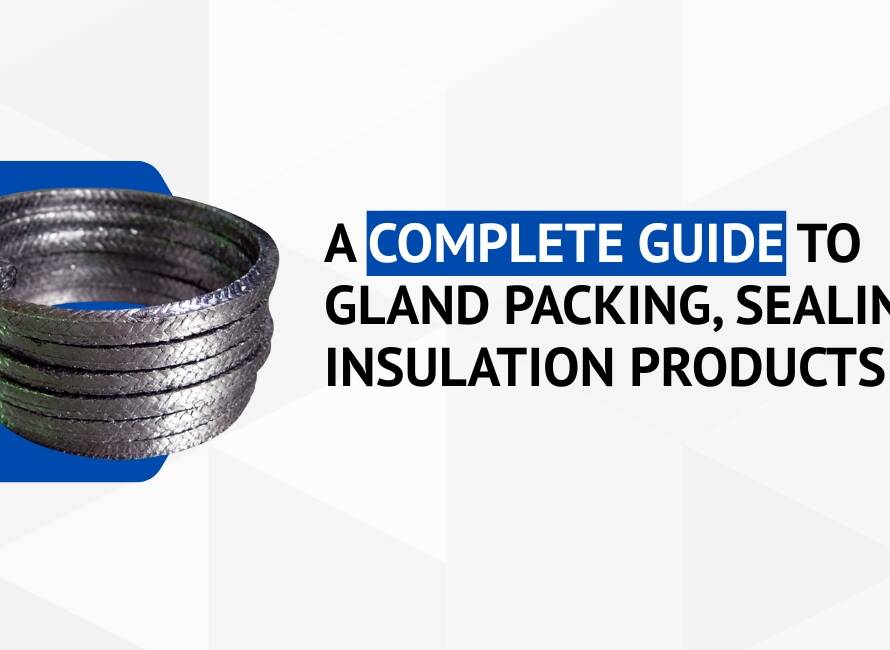
When it comes down to rotating and reciprocating equipment, sealing performance is never just about preventing leaks; it directly impacts efficiency, safety, maintenance cycles, and asset life. One of the most widely used and time-tested sealing solutions in heavy industry is gland packing.
Despite a rise in mechanical seals, gland packing continues to be a preference across multiple sectors owing to its adaptability, durability, and cost-effectiveness.
This guide explains what gland packing is, how a gland packing seal works, the types of industrial gland packing, and why it remains critical in modern industrial operations.
What Is Gland Packing?
Gland packing is a mechanical sealing solution used to control leakage in equipment where a shaft or rod passes through a stationary housing. It consists of braided or molded packing rings that are compressed inside a stuffing box or gland chamber. When tightened, the packing creates a controlled seal around the moving shaft while allowing limited movement and lubrication.
Contrary to mechanical seals, gland packing does not depend on precision-machined faces.
Instead it relies on controlled compression, material resilience, and lubrication to maintain sealing integrity under dynamic operating conditions.
Industries rely on gland packing in applications where:
- Operating conditions are harsh or variable
- Equipment misalignment is common
- Maintenance access is required without complete shutdown
- Leakage control is acceptable within regulated limits
How a Gland Packing Seal Actually Works
A gland packing seal functions by balancing three critical forces:
- Radial pressure from the packing against the shaft
- Axial compression applied by the gland follower
- Lubrication film between the packing and shaft surface
When appropriately installed and adjusted, the packing allows a micro-leakage that dissipates heat and prevents shaft damage. Over-tightening is one of the most common causes of premature packing failure, leading to excess friction, shaft wear, and energy loss.
Experienced gland packing manufacturers design packings that –
- Maintain elasticity under pressure
- Resist extrusion and chemical attack
- Operate across wide temperature and pressure ranges
Types of Industrial Gland Packing
Selecting the right industrial gland packing depends on process conditions, fluid media, temperature, pressure, and shaft speed. Below are the most commonly used materials in industrial environments.
1. PTFE Gland Packing
PTFE (Polytetrafluoroethylene) packings are widely used for their chemical inertness and low friction.
Key characteristics:
- Excellent resistance to aggressive chemicals
- Suitable for food, pharmaceutical, and chemical plants
- Low coefficient of friction reduces shaft wear
PTFE gland packing is often chosen for applications where major concerns include contamination and chemical compatibility.
2. Graphite Gland Packing
Graphite packings are known for their high-temperature performance and thermal conductivity. Key characteristics:- Operates effectively in high-temperature steam and thermal fluid systems
- Self-lubricating properties
- Handles high pressures and shaft speeds
3. Aramid Fiber Gland Packing
Aramid-based packings are designed for high mechanical strength and abrasion resistance.
Key Characteristics:
- Excellent resistance to wear and extrusion
- Suitable for abrasive slurries and high-pressure pumps
- Often combined with PTFE or graphite for improved performance
These packings are frequently used in mining, pulp & paper, and wastewater applications.
4. Carbon Fiber Gland Packing
Carbon fiber gland packing offers a balance of strength, thermal stability, and chemical resistance.
Key characteristics:
- Withstands high temperatures and pressures
- Good dimensional stability
- Compatible with oils, hydrocarbons, and steam
Carbon-based packings are preferred in petrochemical and heavy process industries where reliability is critical.
Common Industrial Applications of Gland Packing
Industrial gland packing continues to be widely used across sectors such as:
- Centrifugal and reciprocating pumps
- Valves and control valves
- Agitators and mixers
- Compressors
- Heat exchangers
Industries including power generation, oil & gas, chemicals, fertilizers, steel, cement, pulp & paper, and marine operations rely on gland packing due to its versatility and ease of maintenance.
Benefits of Gland Packing vin Industrial Operations
Despite advancements in sealing technology, gland packing offers several advantages that keep it relevant:
1. Adaptability to Harsh Conditions
Gland packing tolerates shaft misalignment, vibration, and fluctuating pressures better than many precision seals.
2. Ease of Installation and Maintenance
Packing rings can be installed and adjusted on-site without specialized tools, reducing downtime.
3. Cost-Effectiveness
Lower initial cost and simplified maintenance make gland packing economical over the equipment lifecycle.
4. Broad Material Compatibility
From corrosive chemicals to high-temperature steam, packing materials can be tailored to specific process requirements.
5. Safety and Reliability
Properly selected and installed packing provides predictable performance and controlled leakage, improving operational safety and standards.
Gland Packing vs Mechanical Seals
While mechanical seals are often preferred for zero-leakage requirements, gland packing remains a better choice when:
- Equipment operates under fluctuating conditions
- Shaft damage or runout is a concern
- Maintenance teams require quick on-site servicing
- Initial cost constraints exist
In many plants today, both technologies coexist, each selected based on application criticality.
Role of Industrial Sealing and Insulation Products
Gland packing does not operate in isolation. Its performance is closely linked with other industrial sealing and insulation products such as gaskets, expansion joints, thermal insulation materials, and protective coatings. A holistic sealing and insulation strategy helps:
- Improve energy efficiency
- Reduce heat loss and emissions
- Extend equipment life
- Enhance workplace safety
Rex Seal – Trusted Gland Packing Manufacturers in India
As experienced gland packing manufacturers in India, Rex Seal supplies high-performance braided packings engineered for Indian industrial conditions. Their product range includes gland packing made from PTFE, graphite, aramid, and carbon fiber, designed to meet demanding operational requirements.
Beyond manufacturing, Rex Seal also provides technical support and service expertise, helping clients select, install, and maintain the right gland packing seal for their applications. This combination of product knowledge and field experience enables consistent sealing performance and reduced downtime across industries.
Understanding gland packing types, applications, and benefits allows engineers and maintenance teams to make informed decisions that balance performance, reliability, and cost. When sourced from experienced manufacturers and supported by proper installation practices, industrial gland packing continues to deliver dependable results in even the toughest operating environments.